
Top Products
Portables
Fixed Systems
Industry
Specialty Products
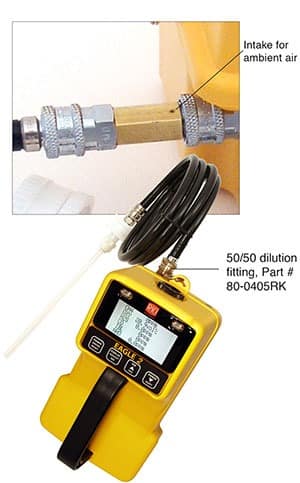
Description
A dilution fitting is a plumbing device that is attached to Eagle or Eagle 2 sample inlet port, and then the sample hose is attached to the dilution fitting. When used, the sample flow going into the instrument passes through the dilution fitting. The dilution fitting has 2 small holes; one is in the sample gas stream path, and the second is through the side of the fitting and causes the instrument to take in ambient air. Essentially, the dilution fitting creates a calibrated “leak” into the incoming sample, and dilutes the sample with fresh air. If the dilution fitting is calibrated to be 1 to 1, then when used it will dilute the sample gas stream with an equal amount of ambient air.
When is a dilution fitting needed?
There are at least two situations where a dilution fitting is needed. The first common usage is when a catalytic LEL sensor is used to test a space that is inerted (contains no oxygen). Since a catalytic sensor requires oxygen in order to operate, a 1 to 1 dilution fitting blends enough fresh air with the sample to provide enough oxygen for the sensor to properly detect flammable gases if they are present. The second common reason for using a dilution fitting is to extend the detection range of the gas monitor.
Interpretation
When a dilution fitting is used, it reduces the concentration of the sample gas. If the gas monitor is calibrated to read correctly without the dilution fitting, then when the fitting is used the gas monitor will read lower than what is actually in the gas sample. For example, if a 1 to 1 dilution fitting is used, since it dilutes the sample by 50%, this means that the reading will be half of what is actually present in the test space. In order to calculate the correct reading, it is necessary for the operator to multiply the meter reading by 2. If a dilution fitting is 2 parts dilution to 1 part sample, then it knocks the reading down to 1/3 of the actual value, and in this case it is necessary to multiply the meter reading by 3 to get the actual concentration. So, a reading of 50% LEL is actually 150% LEL.
Cautions
The dilution fitting ratio will be affected by changes in pressure of the incoming gas sample. The fitting is calibrated to provide the correct dilution if the sample is drawn from atmospheric pressure. If the pressure is different, it will change the ratio. For example, if the sample is drawn from a strong vacuum, the fitting may have a difficult time pumping enough gas through the sample hole, and therefore it would draw a larger proportion of the sample through the dilution hole. In this case, you would be getting more dilution of the sample, and so the readings would be lower than expected. If the sample is drawn from a pressurized vessel, it may force too much gas through the sample hole and the pump will not be able to draw the correct amount from the dilution hole. In this case the reading may be higher than expected. In testing an inerted space with a catalytic sensor, if insufficient dilution occurs then the LEL reading may be low or near zero because the catalytic sensor is not responding properly due to a lack of oxygen. It is also critical to make sure the probe filters are clean as this too can cause erroneous (low) readings. The Eagle and Eagle 2 1:1 dilution fitting can be used with any length hose up to 70 ft. (21m).