
Top Products
Portables
Fixed Systems
Industry
Specialty Products
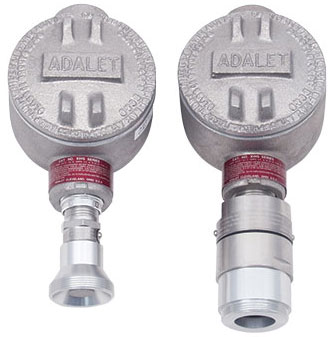
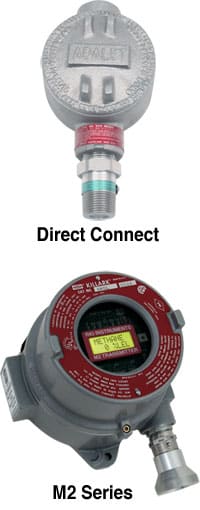 Deciding on the appropriate and most efficient solution for a fixed system application involves evaluations of the environment and decisions about the different ways to monitor that environment. Typical components of a fixed system include a Controller and a Detector. One decision to make is whether to use a Direct Connect sensor or a Sensor/Transmitter for the detector part of the fixed system. Both Direct Connect Sensors and Sensor/Transmitters have advantages that should be understood before deciding on which detector to select.
Direct Connect Sensors
Direct connect sensors offer the advantage of having a lower cost than a sensor/transmitter style, because a direct connect sensor does not utilize a transmitter in its design. A direct connect style detector can only be used with an RKI controller. The signal-processing circuitry normally found in the transmitter is located in the RKI controller for further signal treatment. In a direct connect configuration, the calibration adjustments are performed at the controller, with the test gas being applied to the sensor. RKI’s controllers utilize unique operating software that allows direct connect sensor calibration to be done quickly and easily by only one person. The distances that a direct connect sensor can be located from the RKI controller are appreciable, ranging up to 1,000 ft. with appropriate sized wire. One other advantage of a direct connect sensor is that it can be calibrated without opening the detector enclosure (also known as ‘non-intrusive calibration’), this can be a big cost savings for detectors located in hazardous locations, as a hot work permit is not required.
Sensor / Transmitters
Detector/transmitters send a feedback signal, usually an industry standard 4-20 mA, with 4 mA being the output at zero (gas free atmosphere) and 20 mA, the output at full scale gas concentration. A mA is a unit of measure for electrical current, one thousandth of an amp. Other digital outputs are also available in various formats, for example ModBus, DeviceNet, Lonworks, etc. There are three primary advantages for choosing a detector/transmitter as supplied by RKI. They are:
It is important to remember that RKI’s Direct Connect detectors are designed and intended to work only with RKI controllers. Also, most of RKI’s controllers can accept either direct connect style or detector transmitter styles. These controllers include the models Beacon 110, Beacon 200 and Beacon 410. The Beacon 800 is designed to operate only with detector/transmitter styles. Also, not every gas detector offering from RKI is available in a direct connect configuration. Please consult with RKI regarding your specific applications.
We hope that the above summary of information helps to clarify the major distinctions between Direct Connect Sensors and Sensor/Transmitters.
*Capable of accepting Direct Connect Sensors
